
Updated on March 18, 2026
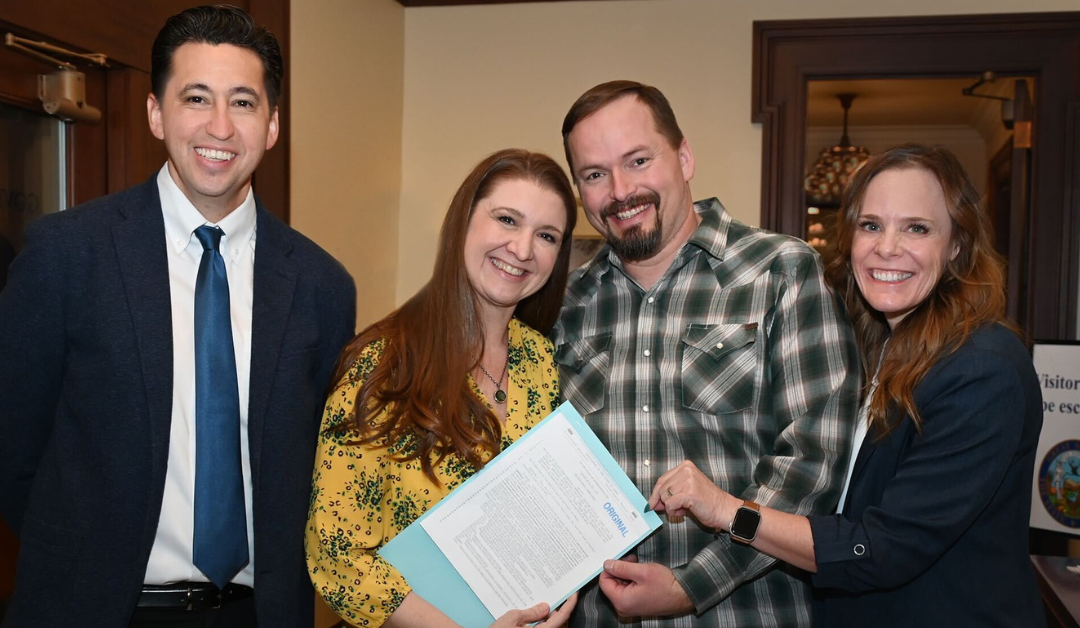
Feature: Left to right, Ricco Garcia of Airbnb Government Relations, Melissa and Jeremy Radford of the Idaho Vacation Rental Association, and IVRA Vice President Cara Hipwell. Photo courtesy of Melissa Radford.
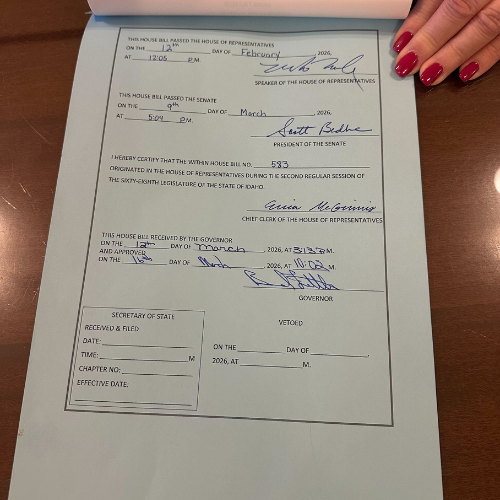
Idaho Gov. Brad Little signed one of the most sweeping state-level preemption laws for short-term rentals in the country on March 16, 2026.
House Bill 583 limits local governments’ ability to impose rules that single out short-term rentals for additional requirements. It also classifies short-term rentals as a “nontransient residential use” for zoning and building code purposes, an important distinction that aligns them more closely with long-term housing.
“We are grateful to Governor Little for signing House Bill 583 into law, establishing a clear and consistent standard for how Idaho treats homeowners who rent their property,” said Melissa Radford, Vice President of Advocacy at the Idaho Vacation Rental Association (IVRA).
Consistency with long-term rentals
The bill requires that local laws treat short-term rentals the same as other residential uses. Under the new law, local governments cannot impose rules on short-term rentals that do not also apply to traditional single-family homes and similar residential structures. The statute defines prohibited “different restrictions or obligations” in detail. They include: owner-occupancy requirements, restrictions on rental days, caps on the number or proximity of short-term rentals, additional parking, insurance, or structural upgrades; or mandatory reporting on rental activity.
The law also bars local governments from requiring a license, fee, permit, certification, or registration to operate a short-term rental.
What cities can still regulate
The bill preserves local health and safety requirements so long as jurisdictions apply them consistently to short-term and long-term rentals. Cities and counties may continue to require smoke alarms in sleeping areas, fire extinguishers and carbon monoxide detectors on each floor, escape ladders for sleeping areas, occupancy limits per state building codes, and emergency information for guests.
Short-term rentals and their guests will continue to be required to follow local rules, including noise, parking, nuisance, and traffic ordinances.
Tax collection and platform provisions
HB 583 also clarifies the role of short-term rental platforms in tax collection.
Platforms such as Airbnb and Vrbo must register with the Idaho State Tax Commission and are responsible for collecting and remitting applicable state and local taxes on bookings they facilitate. At the same time, the law prohibits local governments from imposing taxes or fees specifically on the operation of a short-term rental marketplace.
Vote caps years of debate
The legislation follows multiple failed attempts in recent years to define the boundaries of local regulation. HB 583 emerged as the more expansive of two proposals considered this session. It passed the Idaho House 54-to-16 and the Senate 23-to-12, with support from a broad coalition of lawmakers and industry groups.
Melissa of IVRA said the legislation addressed STR operators’ concerns about inconsistent and overly restrictive local rules.
“With support from 77 legislators across both chambers, Idaho has sent a strong message: homeowners deserve equal treatment under the law, whether they rent short-term or long-term,” Melissa said. “This law ensures fair and consistent protections for all responsible homeowners while preserving every tool communities need to safeguard health, safety, and quality of life. IVRA now turns its focus to helping Idaho homeowners understand their rights and responsibilities under the new law.”
Ongoing tension at the local level
Approval of the bill follows years of friction between state lawmakers and local governments, particularly in resort communities such as McCall and areas around Bear Lake, where officials have sought more local control over short-term rentals, according to the Idaho Mountain Express.
During the session, the bill’s opponents argued that limiting local authority could make it harder to address housing affordability, workforce shortages, and neighborhood impacts.
Some lawmakers warned that the issue is far from settled, suggesting the Legislature may revisit the balance between state preemption and local control in future sessions, the Idaho Mountain Express reported.
Because the bill includes an emergency clause, it will take effect on July 1, 2026.
Between now and then, local governments will need to review existing ordinances to determine which provisions conflict with the new law. In many cases, local rules, particularly those related to licensing, density caps, or owner-occupancy, may need to be repealed or revised.
…
GET UPDATES