
Updated on April 8, 2026
A closely watched legal challenge to Montana’s new second-home tax will proceed through the lower courts after the Montana Supreme Court declined to take up the case on an emergency basis.
In a March 31, 2026, order, the Court rejected a petition from Gov. Greg Gianforte to bypass the normal judicial process and bring the constitutional question directly before the state’s highest court. Instead, the justices ruled that the case should continue through the district court, where it was originally filed earlier in the year.
Court defers to standard legal process
The second-home tax was enacted as part of Senate Bill 542, a 2025 omnibus package that overhauled Montana’s property tax structure. The law rolls back property tax rates for primary residences while increasing rates for second homes and short-term rentals.
In his request, the governor argued that the case raises “constitutional issues of major statewide importance” and warned that leaving it in the lower courts would prolong taxpayers’ and local governments’ uncertainty.
The Court’s ruling focused narrowly on whether the case met the threshold for emergency review and did not address whether SB 542 is constitutional. The justices found that the issues of the case did not demonstrate the level of urgency required to bypass the trial court process. They also noted that district courts are equipped to resolve constitutional questions and develop a record for appeal.
Original legal challenge continues
The ruling leaves in place the original lawsuit filed in January 2026 in Gallatin County District Court by current and former state lawmakers challenging SB 542.
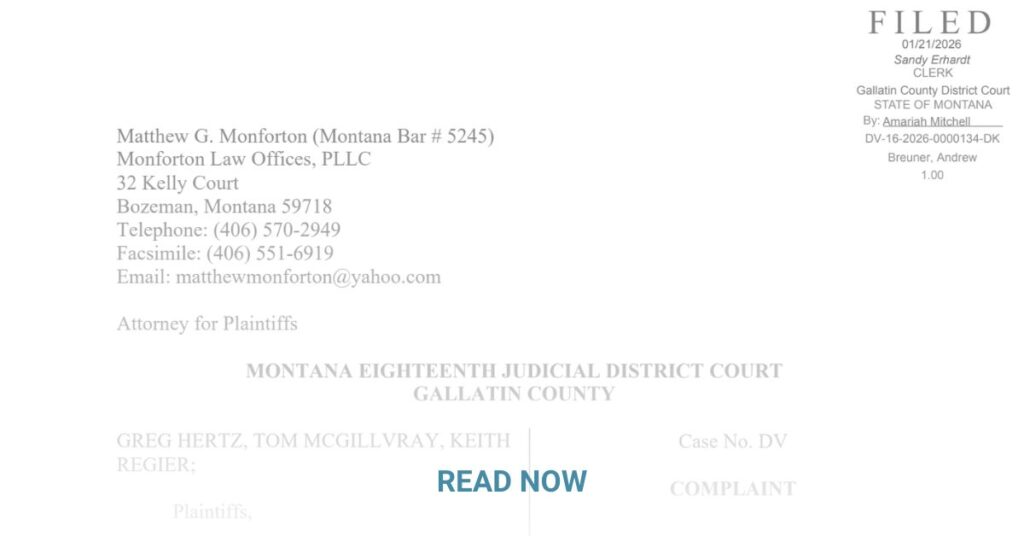
The plaintiffs, Sens. Greg Hertz and Tom McGillvray and former legislator Keith Regier, argue that SB 542 was unconstitutional in the way it was passed, alleging that lawmakers used a deliberate “bait-and-switch” to push the measure through.
In their complaint, they claim that legislators abandoned the bill’s original purpose, a temporary property tax freeze, before its public hearing, then replaced it with a tax overhaul paired with $90 million in one-time rebates to secure votes. The lawsuit claims lawmakers bundled unrelated provisions into a single bill to force an all-or-nothing vote. These provisions included cash payments, permanent tax policy changes, and funding for local governments. The lawsuit further alleges that this maneuver violated two provisions of the Montana Constitution: the requirement that a bill retain its original purpose and the rule that legislation contain only one subject.
They are seeking a declaratory judgment that it is “unconstitutional and void in its entirety.”
The Department of Revenue information page states that the “new property tax structure … continues to promote long-term housing while distinguishing primary residences and [long-term] rentals from second homes and short-term vacation properties.”
Owner-occupied homes and long-term rentals benefit from lower, tiered rates designed to ease pressure on housing supply, while nonprimary residences, including second homes and short-term rentals, are taxed at a flat rate of about 1.9%.
The case remains in its early stages and has had no oral arguments to date. However, the case could ultimately return to the Supreme Court after a District Court ruling.
Tax remains in effect
The tax structure remains in effect as the legal challenge proceeds, and property owners subject to the second-home classification will likely receive higher tax bills in the fall unless the courts rule otherwise before then.
Montana’s SB 542 is part of a growing pattern. Lawmakers in other states have considered similar policies, raising taxes on second homes. In Colorado, for example, House Bill 1036 would have allowed local governments to tax vacant homes to fund workforce housing, but the measure was tabled after strong opposition from industry groups and local stakeholders.
…
GET UPDATES