

Updated on September 12, 2025
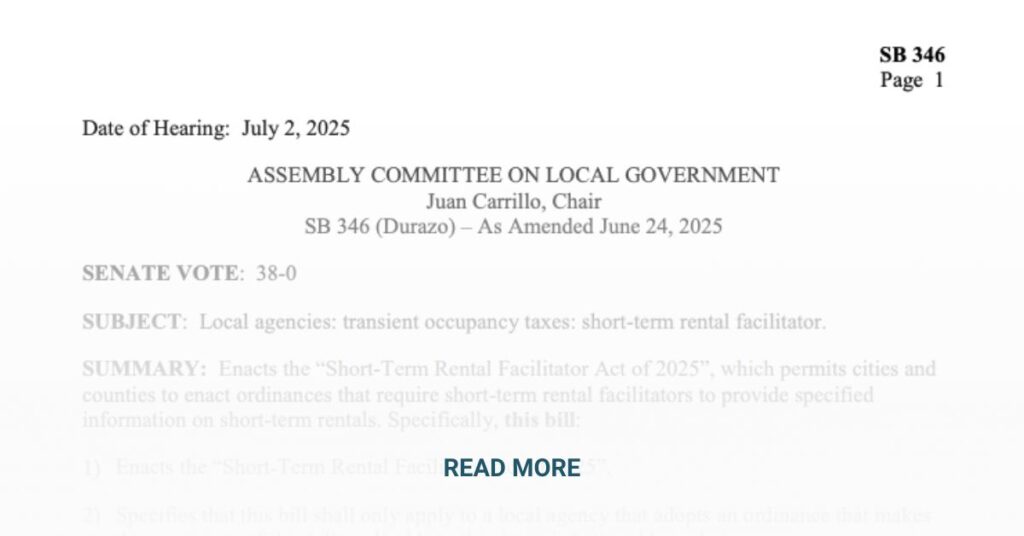
California’s legislature has passed Senate Bill 346, authorizing local governments to mandate that short-term rental platforms like Airbnb and Vrbo share host and property data with local governments to enhance enforcement of lodging taxes and regulations.
Known as the California Short-Term Rental Facilitator Act, the bill passed the Assembly with a 64-0 vote and 15 abstentions on Aug. 29, 2025, and the Senate followed with unanimous approval on Sept. 2, 2025.
Gov. Gavin Newsom has until Oct. 12 to either sign the bill into law or issue a veto. The latter is unlikely given broad support for the measure.
The bill’s author, Sen. Maria Elena Durazo, D-Los Angeles, said the measure addresses a chronic problem of short-term rentals operating outside local ordinances. An estimated 25% to 75% of short-term rentals operate “without proper licenses,” resulting in substantial unrealized revenue for local jurisdictions, she said in a prepared statement.
The legislation authorizes local governments to demand STR property addresses, assessor parcel numbers, listing URLs, and ZIP codes from platforms. It also requires listings to contain the host’s local license number and transient occupancy tax (TOT) certification.
Local agencies may impose administrative fines or request audits if platforms fail to comply.
The League of California Cities and the Association of County Treasurers and Tax Collectors cosponsored the bill.
“SB 346 ensures that every California city has the information needed to enforce its local short-term rental laws, crack down on illegal units and collect the correct amount of transient occupancy taxes owed to them,” said Carolyn Coleman, League of California Cities Executive Director and CEO.
Airbnb raised concerns about the proposal during legislative hearings. In testimony to lawmakers, the company argued that while the bill’s goal to improve city tax collection is understandable, the proposed data requirements are an overreach.
Airbnb stated that the bill’s language “requires a potentially broad collection of hosts’ private and sensitive information that is unnecessary for tax collection, threatens hosts’ privacy, and violates federal law.”
Airbnb noted that it already shares limited, audit-related information like addresses and gross rental receipts with local governments.
The platform urged lawmakers to amend SB 346 to require a legal request, such as a subpoena, before granting access to private host data. Airbnb also highlighted its City Portal, which allows local officials to cross-check listings in hundreds of jurisdictions for compliance.
Commenting on the legislation, Alyssa Stinson, Expedia Group’s Government Affairs Manager for California, said: “We appreciate the importance of driving a high rate of compliance with local transient occupancy tax laws. We already work closely with local governments to develop regulations that meet each community’s needs, often including streamlined tax collection.”
…
GET UPDATES