

Updated on January 27, 2026
Photo courtesy of High Point Market
Twice a year, for five intense days, High Point, North Carolina, welcomes more than 75,000 visitors. These guests descend on a city of less than 120,000 residents for the world’s largest home furnishings trade show. The city’s hotel rooms cannot, and have never been able to, accommodate all of the guests. So, for more than a century, High Point has relied on local residents opening their homes to visitors.
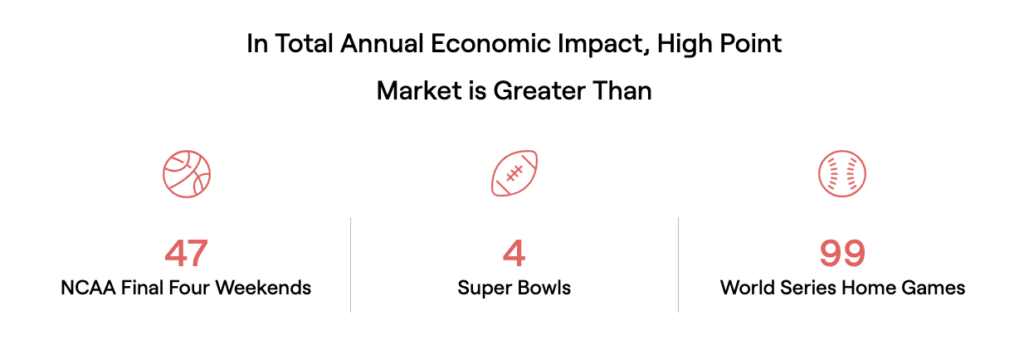
The stakes are enormous. The High Point Market, known locally simply as “Market,” generates an estimated $6.73 billion in annual economic impact for North Carolina. This makes it the state’s single largest economic event, drawing buyers, designers, and exhibitors from around the world. For High Point, the Market is the backbone of many jobs, tax revenue, and local businesses throughout the city, and it depends, fundamentally, on the city’s ability to host tens of thousands of visitors twice a year.

Origins of home-sharing
The High Point Market was founded in 1909, when the city was emerging as a hub of furniture manufacturing and trade. As the Market grew, so did the number of buyers and exhibitors arriving from out of town, often staying for days or weeks. Local residents offered guest bedrooms and, sometimes, their entire houses to host the increasing number of visitors.
“In order to keep those market goers satisfied and to be as close to those showrooms as possible, the notion of renting out your home to accommodate those guests was really a cool way to make Market a shared community value,” said Melody Burnett, President of Visit High Point. “Everybody wanted a part of the success of Market, even if you weren’t naturally a part of Market.”
By the mid-20th century, this form of Southern hospitality had become organized. A 1957 pamphlet produced by the High Point Chamber of Commerce, and now in the High Point Museum’s archives, instructed residents on how to list spare rooms and entire homes, outlined expectations for fresh towels and linens, and provided guidance on pricing.
For decades, The Chamber operated a Housing Bureau that matched Market visitors with local homeowners, said Marian Inabinett, Curator at High Point Museum.
When the Chamber’s Housing Bureau disbanded in the late 1990s, the practice continued and became more professional. Responsibility shifted to the Furniture Factories’ Marketing Association (now named the High Point Market Authority) and to professional rental managers like Patti Holtzman.
Professionalizing hosting
Decades before “Airbnb” became part of global vernacular, Patti was finding ways to improve short-term renting for both hosts and guests.
In the early 1980s, Patti worked as a receptionist at a furniture showroom. She watched visiting sales reps struggle with accommodations that didn’t match expectations or suit their needs.
“The reps at that point were getting their houses through the High Point Chamber of Commerce, but the Chamber of Commerce did not go out and see the houses,” Patti said. “So if somebody sent in a form and said, I have such and such for a house, that’s what the Chamber wrote down. Sometimes, it was accurate, and sometimes it was far from accurate.”
For example, some reps went out to stay at a house fortified with barbed wire and didn’t know how to get in.
“Of course, this was before cellphones,” Patti added.
In other instances, reps reported drug dealers coming to the homes where they were staying, or getting to a house and finding it had only two bedrooms instead of three as advertised.
Patti began informally matching visiting reps with homes owned by friends and neighbors, personally visiting properties, photographing them, and documenting what guests would actually find when they arrived. It started out as a favor for friends and clients she’d met through Market, but over time, she recognized the need for her services and developed a system of practices that gained her a following.
In 1985, Patti founded Market Rentals as a seasonal property management firm that offered systematic guest and home screening, verification, and listings that set realistic expectations for guests.
Market Rentals’ system for matching guests and hosts reduces some of the risks associated with renting to guests from booking platforms. Guests typically come from furniture companies or are referred by other Market participants. Patti checks references and inspects homes, and this quality control largely ends in good experiences for both hosts and guests.
It doesn’t hurt that Market visitors tend to be “ideal” guests because they’re gone most of the day buying or selling, she said.
“They don’t do anything but sleep, shower, use your coffee pot, and leave.”
Over decades, that predictability shaped local perception. Renting out a home during Market lost any perceived risk and was even seen as a civic duty.
Guests often return year after year to the same homes. Hosts and guests form friendships and even exchange holiday cards.
Community standards and self-regulation
High Point’s acceptance of short-term rentals has been reinforced through shared norms maintained by community cooperation rather than formal enforcement.
The High Point Market Authority, Visit High Point, and rental agencies like Patti’s all play distinct but complementary roles in upholding those expectations. To improve safety and the overall Market experience, the Market Authority routinely reviews data from the High Point Police Department related to service calls during Market weeks, said authority CEO Tammy Covington.
In one instance, that data revealed that guests calling 911 from short-term rentals were sometimes unable to provide their address. The Market Authority responded by advising hosts to post the home’s address on the refrigerator so guests could quickly relay their location in an emergency.
That kind of practical, data-driven response helped normalize responsible hosting before the short-term rental industry began setting its own standards.
Visit High Point encourages high standards through promotional incentives. Short-term rentals can be featured in the DMO’s Partners of Excellence program by meeting specific criteria, including a minimum rating of 4.0 on Google or Facebook, at least 10 reviews, and other quality standards.
All of this has culminated a culture of self-regulation. With relatively few negative experiences, short-term renting in High Point avoided the nuisance stigma that has led to regulatory battles in many other jurisdictions across the nation.
STR regulations
That long history of self-management in many ways shaped how city leaders approached regulation. The City of High Point has no ordinance governing short-term rentals.
“We never passed anything,” said Victor Jones, a short-term rental host who served six years on the High Point City Council. “We had some slight chatter from people saying that they wanted to not have short-term rentals in their neighborhood, but it wasn’t significant enough that it got the attention of the city council.”
He also pointed out that, as Chair of the Public Safety Committee, data on calls for service show short-term rentals are negligible, especially when compared to other forms of commercial activity.
Instead of passing a special ordinance for short-term rentals, city officials use existing nuisance laws to address noise, parking, and safety.
Services for short-term rental guests
At the same time, the High Point Market Authority has long invested in services that anticipate guests staying not only in hotels, but also in private homes across the city. During Market, the Authority provides shuttles for visitors from hotels and short-term rentals to showrooms throughout High Point, reducing downtown congestion and the need for renting a vehicle.
“[Private homes are] so much in the DNA of this show just because we’ve been doing it so long,” Tammy said. “One of the reasons High Point has been successful at keeping an event here for 116 years is that Southern hospitality … and … private home rentals [are] an integral part of that.”
Year-round demand
While Market remains High Point’s anchor, its role has evolved as the city’s appeal broadens.
New drivers, including High Point University, sports tourism, downtown events, and cultural programming, have turned the city into a year-round destination, extending lodging demand beyond the twice-annual rush, said Rebekah McGee, President and CEO of Downtown High Point.
Even with the addition of a downtown hotel, demand still outpaces supply, Rebekah said.
“We still don’t have the hotel rooms that we need,” she said.
Short-term rentals help meet the need for places to stay, especially for families, longer visits, and groups that hotels can’t always serve well. Rebekah sees these rentals as a helpful part of the city’s infrastructure.
“You’re probably going to trust a local person better than you will an app,” she said.
Through initiatives like High Point x Design, local leaders and industry partners are working to extend the city’s design identity beyond Market weeks, using exhibitions, programming, and events to attract visitors year-round. The strategy builds on High Point’s existing strengths while smoothing out the peaks and valleys that once characterized its visitor economy.
Inclusive hospitality
High Point is also taking big steps to welcome other underserved groups, including travelers with autism or sensory sensitivities.
In 2023, High Point became the first Certified Autism Destination on the East Coast and the second in the United States. The designation from the International Board of Credentialing and Continuing Education Standards means that autistic and sensory-sensitive travelers can expect trained staff, inclusive environments, and accessible experiences throughout the city.

“So first it started with our hospitality sector and our traditional hospitality sector: hotels, entertainment venues, attractions, dining,” Melody said.
Staff at participating businesses completed specialized training to better serve guests on the autism spectrum and their families.
“But then, because of our partners like High Point by Design and the Market Authority, and the Realtors, we were like, ‘Wait, this training, and this mindset, goes way beyond just the face of hospitality being traditional. We gotta make sure that our Airbnbs are trained and that our Realtors are trained, too,’” Melody recounted.
After all, visitors interact with more than just hotels and restaurants. Prospective residents might stay in short-term rentals multiple times before deciding to move to the city. Realtors, property managers, and short-term rental hosts all shape visitors’ impressions of the community.
Visit High Point has since offered autism awareness training to the High Point Regional Association of Realtors and encouraged short-term rental hosts to participate as well.
While short-term rentals don’t yet receive formal Certified Autism Center status, which requires structured training and standards, hosts who complete the training can be recognized through Visit High Point’s Partners of Excellence program.
The destination marketing organization also created an Autism Travel Guide featuring certified businesses and providing resources for planning activities. Families can access the guide on the Visit High Point website or request it by mail at no cost.
The autism destination certification builds on the city’s history of hospitality and on its commitment to welcoming all visitors, including those with autism.
Takeaways from High Point
High Point’s model is unique. No other city hosts the world’s largest home furnishings trade show, and few have decades of experience with civic-minded home-sharing tied to a single event.
However, the city offers some takeaway lessons for others.
High Point shows that celebrating a diversity of lodging needs, voluntarily embracing early accountability measures, and valuing hosts as part of the economic fabric help to elevate both short-term renting and benefits to the greater community and economy.
Unlike many cities where short-term rentals remain uncertain, High Point’s experience highlights the benefits of long-term integration into the community.
“We haven’t heard any negative sentiment, and I think it’s just because as High Pointers, we’ve just been conditioned to think about short-term home rentals in a different way,” Melody said. “It’s almost like our responsibilities have legacy standard. The Market needs us; High Point University needs us. There are two economic impact drivers for our community. … Folks want a partnership in that story, and I think [renting out their homes] is their way of doing that.”
…
GET UPDATES