

Updated on September 18, 2025
The Montana Supreme Court has ruled that short-term rentals violate restrictive covenants in a residential subdivision in Flathead County.
The ruling in Brandt v. R&R Mountain Escapes LLC, issued July 22, 2025, interpreted a set of covenants dating back to 1990 prohibiting commercial activity and requiring properties to be used for “country residential living.” The court had previously found similar covenants against commercial use ambiguous; this time, the justices found the language left no doubt.
“We conclude that the unambiguous intent and language of the covenants was to provide for residential country living, including the ability to farm and ranch, with only single-family dwellings used for residential, and not commercial, purposes,” Justice Laurie McKinnon wrote in the opinion. The court found that the short-term rental use by R&R Mountain Escapes, which generated tens of thousands of dollars annually and welcomed up to 10 guests at a time, constituted a prohibited commercial business.
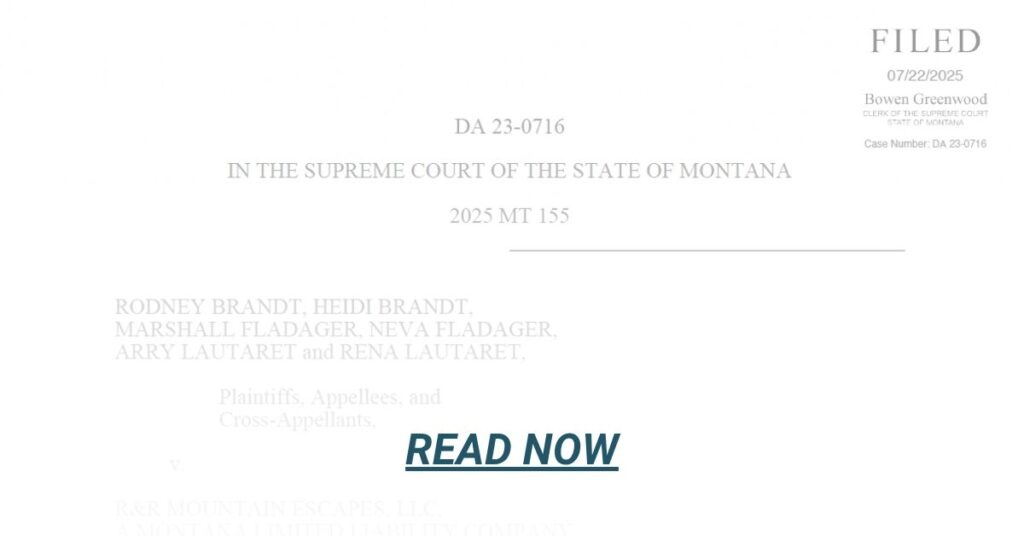
The case stems from a lawsuit by neighbors who said the vacation rental disrupted the character of their rural neighborhood near Whitefish. They claimed the short-term rental presented a nuisance because it increased incidents of traffic, trespassing, and safety breaches. For example, six unattended children once entered a pasture with a bull, and the property owner had to rush to get them out.
R&R Mountain Escapes argued that the covenants did not expressly forbid short-term rentals. They emphasized that such use did not change the building’s function as a residence. But the justices rejected that argument, pointing to the covenants’ multiple restrictions on business activity, multifamily use, and commercial signage. The covenants also “unambiguously prohibit anything that may or may not become an annoyance or nuisance to the neighborhood,” the justices added.
“Taking the whole of these covenants together, with each helping to interpret the other, their language unambiguously prohibits the commercial business of renting out a home on a short-term basis, which undisputedly created a nuisance to other homeowners in the subdivision,” the court wrote.
The decision marks a significant clarification of Montana case law. In 2020, the Montana Supreme Court ruled in Craig Tracts v. Brown Drake that a “residential purpose-only” covenant was ambiguous and did not prohibit short-term rentals. According to the Montana Supreme Court opinion, that case prompted confusion in lower courts and sparked debate over what covenants need to say to restrict STRs.
The court distinguished Brandt from Craig Tracts by pointing to the “multitude of covenants” that, when read together, demonstrate “the underlying intent of the Declaration (covenants).” It also emphasized that while “residential purpose” may be vague, the other language in the covenants was not.
“Considering the plain language of the Declaration as a whole, there is no ambiguity in its language; the Declaration clearly prohibits the commercial business of renting a dwelling for five days with ten guests, as the ‘guests’ are not “living” there as country residents, using the land as farm and ranch tracts, or using the dwelling as a single-family residence, and are, in fact, creating an undisputed nuisance,” Justice McKinnon wrote. “The short-term rental of R&R’s property is more akin to an apartment, which is specifically prohibited by the covenants.”
Justice Cory Swanson, writing separately in concurrence, underscored the importance of the prohibition on commercial activity in combination with the verbiage in the other covenants.
“This is a case of restrictive covenants, imposed by a property owner upon herself as part of her subdivision,” he wrote. “These covenants were voluntarily and willingly accepted by subsequent property owners upon purchase of their land.”
The court stopped short of awarding attorney’s fees to the plaintiffs, finding that the trial court acted within its discretion in denying them. However, the justices reversed one aspect of the lower court’s decision, which relied on Flathead County’s zoning code to infer a 30-day minimum for residential use. The Supreme Court said in this case that the covenants must govern.
The decision creates an unpredictable legal landscape for short-term rental operators. When examining subdivision covenants, it may or may not be clear how a court would rule on whether short-term rentals are permitted when the use is not explicitly prohibited.
…
GET UPDATES